
 by Rony Mattar
On July 16, 2026, Google quietly rolled out a change that says a lot about where search is headed. AI Mode, the conversational search experience inside Google Search, can now connect directly to Instacart, Canva, and YouTube. Ask it about a recipe, and it can add the ingredients straight to your Instacart cart.
Ask for a poster design, and it pulls up Canva templates. All of this happens inside the chat itself, with no click to a website required (TechCrunch, 2026).
Instacart confirmed the integration on its own company blog, noting it builds on similar connections the grocery platform already has with ChatGPT, Claude, and Gemini (Instacart, 2026). In other words, this isn’t a one-off experiment. It’s part of a pattern where AI systems are moving from answering questions about products to completing the purchase itself.
For ecommerce brands, that’s worth sitting with for a minute. A website used to be the place a customer landed before buying. Increasingly, it’s a place AI visits on the customer’s behalf, and the customer may never see it at all.
This Isn’t a Blip, It’s Where the Traffic Already Is
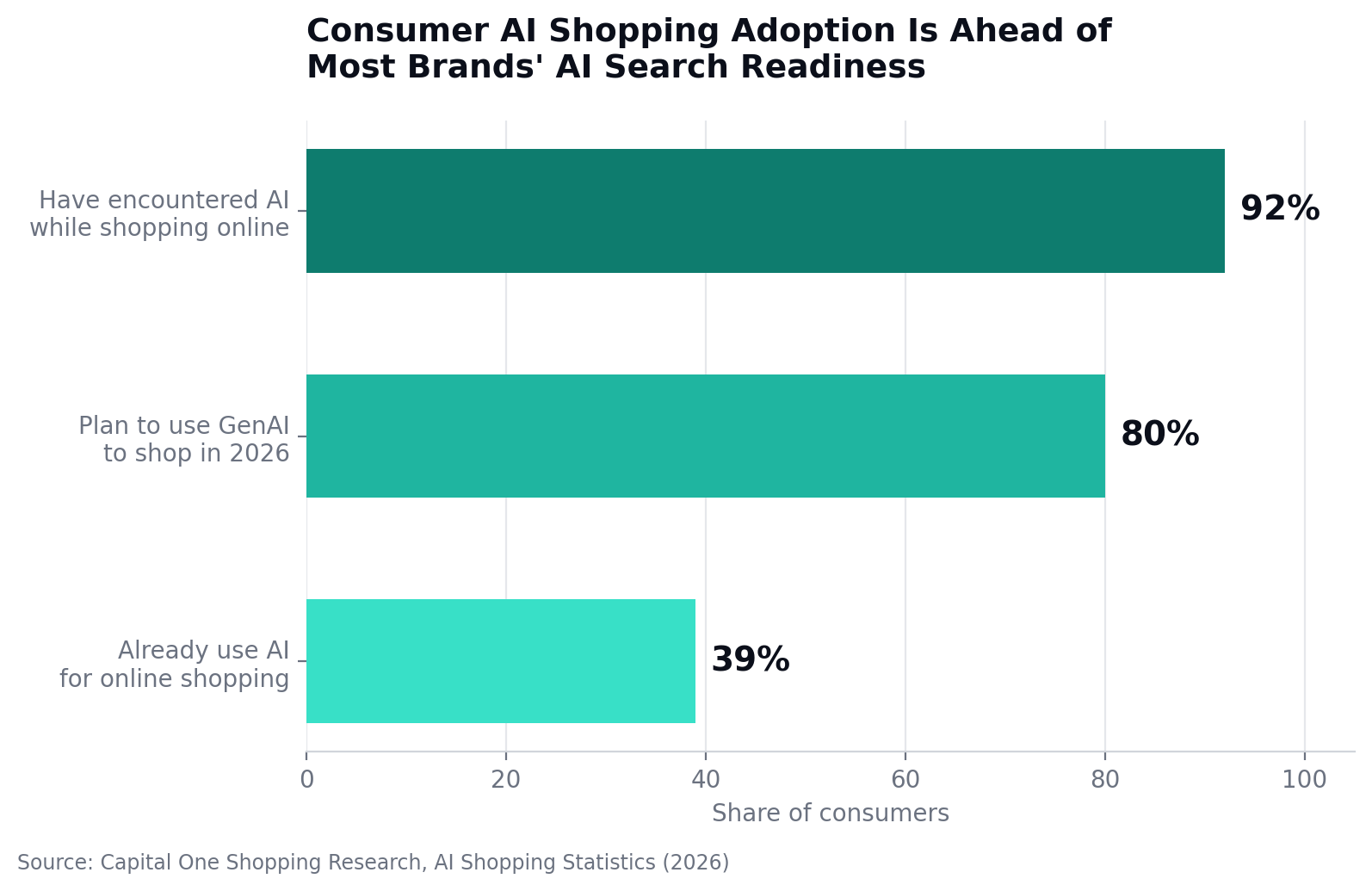
It’s tempting to treat any single product announcement as hype. The adoption numbers say otherwise. According to Capital One Shopping’s 2026 research on AI shopping behavior, 92 percent of consumers have already encountered AI in some form while shopping online, 80 percent plan to use generative AI to shop in 2026, and 39 percent say they’re already using AI tools for online shopping today (Capital One Shopping, 2026).
That last number matters most. Encountering AI is passive. Planning to use it is intent. Thirty-nine percent already doing it is behavior, and behavior is what shows up in a business’s numbers.
The Traffic Reality, By the Numbers
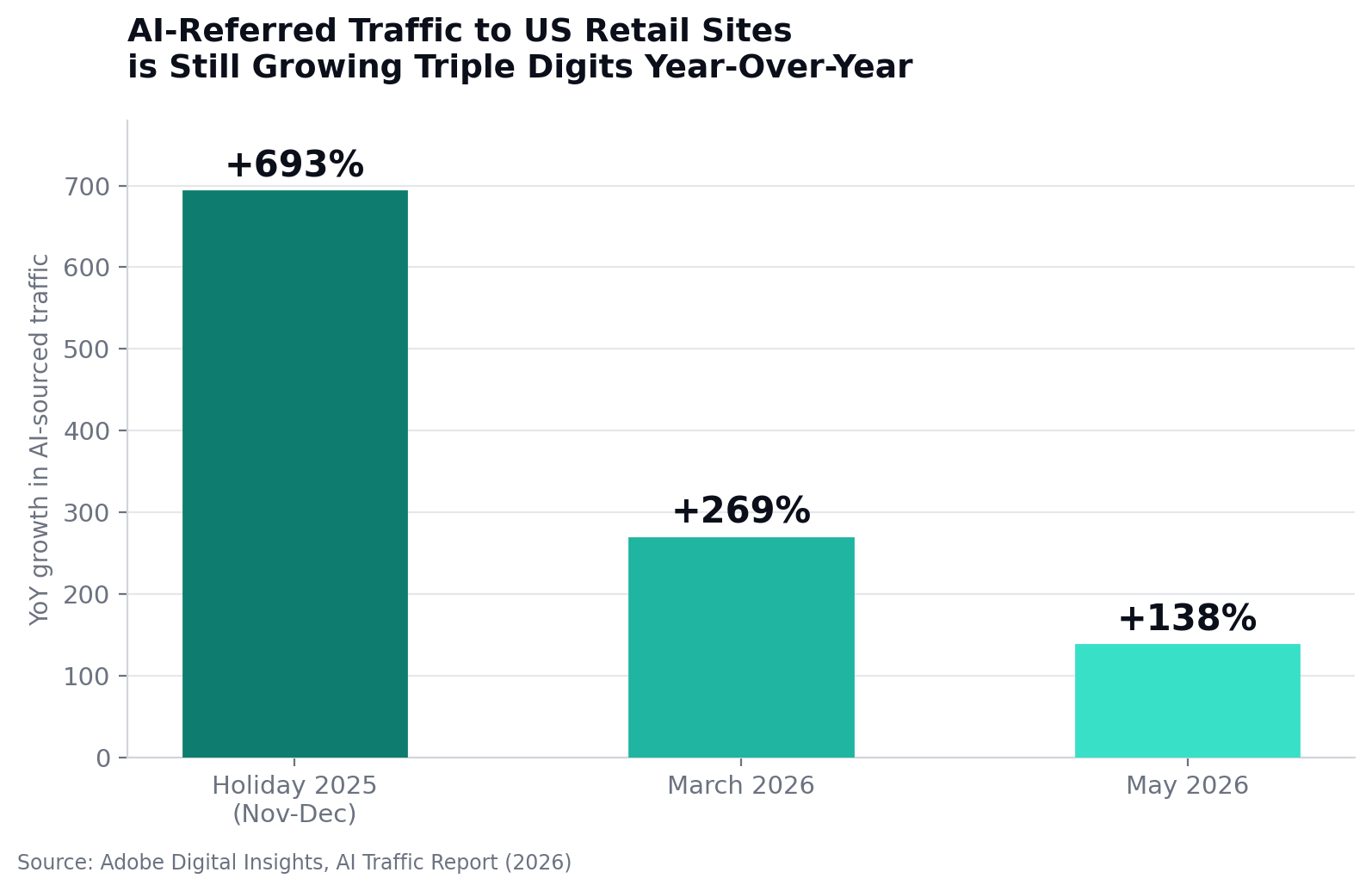
Adobe Digital Insights tracks referral traffic from AI sources to retail sites in the United States, and its quarterly reports give the clearest picture of how fast this is moving. During the 2025 holiday season, AI-referred traffic to retail sites was up 693 percent year over year. By March 2026, that growth rate had cooled to 269 percent. By May 2026, it had cooled further to 138 percent (Adobe Digital Insights, cited in Digital Commerce 360, 2026).
Read those three numbers together and the story isn’t that AI traffic is fading. It’s that the growth curve is doing exactly what a growth curve does once a channel goes from novel to normal: it decelerates while still compounding. Triple-digit year-over-year growth in May, five months after the initial holiday surge, is not a channel cooling off. It’s a channel settling into place.
There’s a second detail in Adobe’s data worth calling out. As of March 2026, traffic arriving from AI sources converted 42 percent better than the site average, a full reversal from March 2025, when that same traffic converted 38 percent worse (Adobe Digital Insights, 2026). Early AI referral traffic was curious and unqualified. A year later, it’s qualified and ready to buy. That shift alone should change how seriously a brand takes its presence inside AI answers.
The Trust Gap Nobody’s Talking About
None of this means shoppers have handed AI the keys to their wallets. A Gartner survey of 322 U.S. consumers conducted in January 2026 found that only 11 percent were willing to let AI make purchase decisions on their behalf, even for low-stakes categories like personal care or household supplies. Slightly more, 31 percent, were comfortable letting AI narrow down their options before they made the final call themselves (Gartner, 2026).
That’s the nuance most coverage of this shift misses. Consumers are using AI constantly to research, compare, and shortlist. They are not yet handing it the final decision. Which means the brand that shows up inside that research and shortlisting phase, clearly, accurately, and consistently, has a real shot at being the brand AI recommends when a human is finally ready to buy.
What Google’s Own Quality Guidelines Say About Winning This
Here’s the part worth paying close attention to. Google has been public for years about how it evaluates whether a page deserves to be trusted, through its Search Quality Rater Guidelines. The framework it uses is called E-E-A-T: Experience, Expertise, Authoritativeness, and Trust. Raters are instructed to look at whether it’s clear who created a page, what firsthand experience or expertise that creator brings, how authoritative the website is on its topic, and whether the content is accurate, honest, and reliable (Google Search Quality Rater Guidelines, 2023).
That framework was built for human search raters judging traditional search results. But it maps almost exactly onto the question an AI model is implicitly asking every time it decides whether to cite, recommend, or route a purchase through a particular brand. AI systems are trained on the same open web that Google’s quality signals were designed to evaluate. A brand with thin product descriptions, no clear authorship, inconsistent information about itself across the web, and no independent citations isn’t just weak on traditional SEO. It’s weak on the exact signals that determine whether an AI system trusts it enough to mention by name.
Practically, that means the fundamentals haven’t changed as much as the headlines suggest. What has changed is who’s reading them. The three things that move the needle are the same three things AdWorks Bid builds into every AI Search Optimization engagement: clean, accurate schema markup that tells both search engines and AI systems exactly what a business sells and who it serves; consistent entity signals, meaning a brand’s name, description, and details match everywhere they appear online, from the website to directories to social profiles; and content that’s structured to actually answer the question being asked, written with real product and category expertise, rather than content stuffed around a keyword.
What to Do About It This Quarter
A brand doesn’t need to overhaul its entire site to respond to this shift, but it does need to know where it stands. A simple starting test: open ChatGPT, Perplexity, or Google AI Mode and ask it to recommend a product in your category. See if your brand comes up, and if it does, check whether what the AI says about you is accurate. If your brand doesn’t appear at all, or the details are wrong, that’s the gap to close first, and it’s usually a smaller fix than it sounds like: schema markup, a cleaned-up Google Business Profile, and product pages that answer real customer questions instead of just listing specs. For a step-by-step walkthrough, see our guide on how to appear in Google AI Overviews.
The click isn’t gone. But for a growing share of shopping journeys, it’s no longer the first interaction a brand gets with a customer. The businesses that treat AI visibility as seriously as they’ve historically treated search rankings are the ones that will still be in the conversation when the purchase decision actually happens.
Don’t Just Rank… Be Recommended!
Related reading: Technical SEO for Lebanon ecommerce | Why your business is not in AI search results | AI engine optimization services