

 by Rony Mattar
Inside a Real AI Search Optimization Engagement: What Actually Gets Done in 90 Days
A client asked me recently what he was actually paying for. Fair question. “AI search optimization” gets thrown around so loosely right now that it barely means anything on its own, so instead of answering him in the abstract, I walked him through the 90 day AI search optimization process step by step, the same way I’ll do here.
There’s no shortcut version of this that still works. Skip a step, and the other three don’t fully make up for it. Here’s what actually happens, week by week.
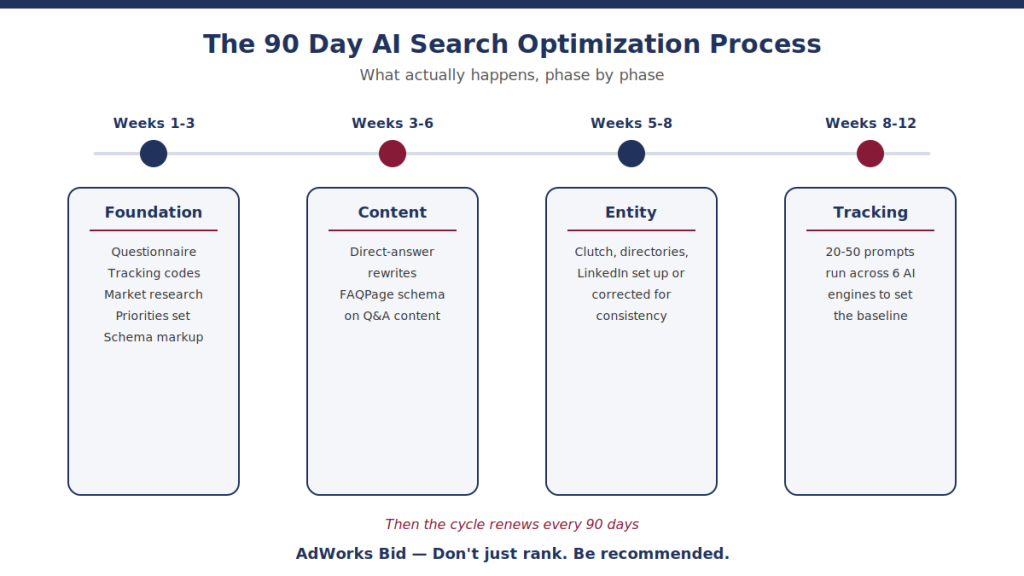
Weeks 1 to 3: Questionnaire, Tracking, Research, and Schema
The engagement starts before any code gets touched. A new client fills out a marketing questionnaire first, covering their business, their customers, and what they actually want out of this. Skipping that step and jumping straight to technical work means building on guesses instead of what the client actually told you.
Once that’s back, tracking codes get installed and configured, Google Analytics, Search Console, and whatever else the business needs to actually measure what happens next. Without this in place first, none of the later work can be measured properly, so it comes before anything else gets built.
With the questionnaire answers and tracking in hand, the next step is market research, building an actual strategy around what the client said matters to them, not a generic template applied to every business the same way. That research also surfaces priorities, since not every business needs the same things fixed first. A business bleeding visibility to a specific competitor gets a different priority order than one that’s simply never had any structured content at all.
Only once priorities are set does schema markup begin. The right schema depends on the business, LocalBusiness or ProfessionalService for an agency, Product and BreadcrumbList schema for an ecommerce store, Organization schema tying everything to a central entity. This gets implemented directly in the code, validated against Google’s Rich Results Test, and checked against what the rest of the business’s online presence says. Schema that contradicts a Google Business Profile or a LinkedIn description can hurt more than having none at all, so this step gets done carefully, not treated as a checklist item to tick off quickly. We’ve written more on what correct implementation actually looks like in our guide to schema markup for Lebanon businesses.
Weeks 3 to 6: Content Transformation
Most business websites are written to describe services, not to answer questions. This phase rewrites and restructures existing content, and adds new content, in a direct-answer format. Instead of “we provide comprehensive marketing solutions,” a page states plainly what problem it solves and how, in the first paragraph, with supporting detail after.
This is also where FAQPage schema gets added to any page with genuine question-and-answer content, since it’s one of the more reliable routes into AI Overview citations. The rewrite work overlaps with the entity work in the next phase more than people expect, since a page that answers questions clearly also does a better job of reinforcing who the business actually is, which ties back to the entity SEO guide we published on exactly this topic.
Weeks 5 to 8: Entity and Citation Building
This is the part that happens outside the website itself. Setting up or correcting profiles on Clutch, relevant directories, and LinkedIn, making sure the business name, address, phone number, and description match exactly everywhere they appear. Every inconsistency is a small dent in how confidently an AI system can identify and trust the entity behind the website.
This phase tends to be slower than people expect, mostly because it involves waiting on directories to approve listings or update information, not because the work itself is complicated. It’s also the phase clients notice the least day to day, even though it quietly does a lot of the heavy lifting behind whether an AI engine trusts the brand enough to cite it later.
Weeks 8 to 12: Prompt Tracking
This is where you find out whether any of the above is actually working. A spreadsheet of 20 to 50 realistic prompts gets built for the client’s specific industry and services, then run across ChatGPT, Google AI Overviews and AI Mode, Perplexity, Gemini, Copilot, and Claude. Each result gets logged, is the business mentioned, how prominently, and what’s said about it.
This becomes the baseline for every future report, and it’s the only honest way to know if visibility on AI engines is actually improving instead of just assuming it is because the other three phases got done. According to Google’s own documentation on AI features in Search, structured, well-corroborated content is one of the clearer signals these systems weigh when deciding what to surface, which is exactly what the first three phases of this process are building toward.
What This Looks Like Month Over Month
None of this is a one-time fix. Schema needs updating as services change. Content needs to keep expanding to cover more of the questions a business’s actual customers are asking. Entity signals need occasional cleanup as directories change their formats or a business updates its details. Prompt tracking gets rerun regularly to measure real movement, not guesswork.
The honest version of the 90 day AI search optimization process is less exciting than the marketing around it suggests. It’s methodical, it’s mostly invisible to a casual visitor, and it takes a few months before the results are clearly measurable. But it’s also the only version that actually changes whether a business shows up when someone asks an AI engine for a recommendation, rather than just hoping it does.
Which Version of This Process Fits Your Business
The 90 day cycle above isn’t a one-size-fits-all engagement, it scales depending on how much ground needs covering.
Growth Foundation runs the core version of this process, schema, content transformation, and AI search integration built to get a business found on Google and on AI engines like ChatGPT and Gemini for the first time. It’s the right starting point for a business that’s never had any of this in place.
Market Domination runs the same process at a wider scope, extending content transformation across LinkedIn and YouTube in addition to the website, and tracking AI engine visibility more closely across more platforms. It suits a business that already has some foundation but needs broader coverage and a stronger footprint.
Total Domination adds a dedicated account manager, deeper technical implementation, digital PR and authority link building, and full entity and E-E-A-T authority work on top of everything above. It’s built for a business that needs the complete version of this process running continuously, with tighter reporting and faster turnaround.
Whichever fits, the same principle holds: this isn’t a one-time fix. Each package runs on the same 90 day cycle described above, and it renews every 90 days, since schema needs updating as services change, content needs to keep expanding, and prompt tracking needs to keep running to confirm the visibility gains are holding, not just showing up once and fading.
Don’t just rank. Be recommended!
Related reading: What is AIO | Entity and citation building for AI search | AI engine optimization services by AdWorks Bid