
 by Rony Mattar
For years, ranking first on Google was the finish line. Get that top spot, get the clicks, get the customers. It made sense, because that top result was the first thing a person actually saw and clicked on. Every SEO strategy, every keyword plan, every backlink campaign existed to serve that one goal.
That’s no longer where the finish line sits, and it’s worth being honest with yourself about why.
The click is disappearing before it happens
Google’s AI Overviews now answer a huge share of searches directly on the results page, before a person ever scrolls down to the traditional list of links. Someone searching “best accountant in Jounieh” or “which agency handles technical SEO in Lebanon” may get a direct answer with a small number of businesses named, and never click through to compare the rest.
If your business isn’t one of the names in that answer, ranking third or fifth or tenth underneath it doesn’t help you the way it used to. You could have a technically flawless page and still lose the moment entirely, because the moment happened before your link was ever visible. Our guide on how to appear in Google AI Overviews breaks down exactly what determines whether your content gets pulled into that answer box in the first place.
Being Recommended by AI is a different kind of win
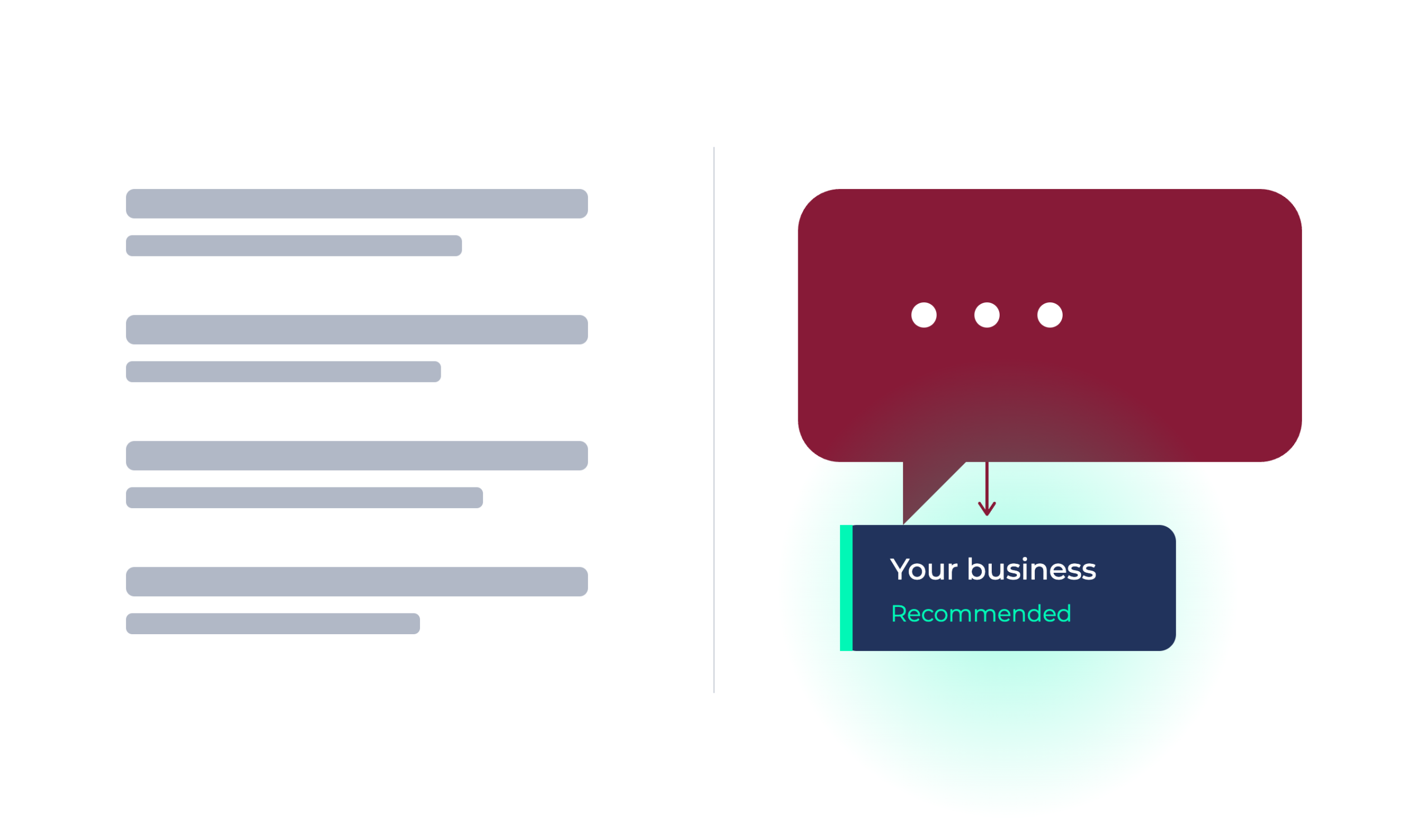
Ranking first on Google means Google’s algorithm decided your page was the most relevant match for a search query. Being recommended by AI means the system evaluated the available options and picked yours to present as the answer directly. That’s a meaningfully different kind of endorsement.
It’s closer to a person calling a friend and asking who they should hire for this, and the friend naming one or two specific businesses, not handing over a list of ten to sort through. A ranking asks the customer to keep evaluating. Being recommended by AI ends the evaluation for them, before they’ve compared anyone else.
This distinction is the whole idea behind the difference between SEO and AIO. SEO gets you in front of someone still comparing options. AIO gets you named as the answer. If you haven’t drawn that line clearly for yourself yet, it’s worth reading through the difference in more detail.
This shows up hardest in B2B buying decisions
Enterprise buyers doing real research, evaluating vendors, benchmarking service providers, checking who else in the industry has solved a similar problem, increasingly run part of that research through AI engines before ever picking up the phone. If a competitor is named in that early research and you’re not, you’ve lost part of the decision before you knew it was being made.
This is a bigger deal for B2B companies than it might first appear, because B2B buying cycles are longer and involve more silent research than consumer purchases. A procurement lead asking ChatGPT “which agencies in Lebanon do technical implementation, not just audits” is making a shortlist decision right then, with no salesperson in the room to correct a wrong impression. We go into this in more depth in our piece on AI search optimization for B2B companies in Lebanon, including why enterprise buyers across the GCC are particularly exposed to this shift.
Why some businesses get named and others don’t
This isn’t random, and it isn’t about who has the biggest marketing budget either. AI engines build a model of who to trust based on a specific set of signals: whether your entity is consistent across the web, whether your content is written in a format that’s easy to extract an answer from, and whether other sources on the internet back up what you say about yourself.
A business with a clean, consistent entity across its website, its directories, and its social profiles gives an AI system something solid to point to. A business whose name, description, and details contradict each other across different sources gives the AI system a reason to default to someone else. That’s exactly why entity work has quietly become one of the more important parts of AI visibility. Our article on entity SEO in Lebanon covers how Google and AI systems build that picture of trust, and how to make sure yours is being built correctly.
Structured data plays a role here too. Schema markup is essentially how you tell an AI system, in a format it can read directly, what your business does and who it serves. Without it, the system is guessing. With it, the system has something concrete. If schema isn’t something you’ve properly implemented yet, our schema markup implementation guide walks through exactly what correct implementation looks like, not just the recommendation to “add schema” that most audits stop at.
What this means for local businesses, not just enterprise ones
It’s easy to assume this shift only matters for large B2B companies chasing enterprise contracts, but it’s just as real at the local level. Someone asking “recommend a reliable dentist in Beirut” or “which construction company in Lebanon handles mixed-use projects” through Perplexity or ChatGPT is making the same kind of decision, just at a smaller scale. Local search hasn’t stayed the same either, and the fundamentals that used to be enough on their own, like Google Business Profile optimization and NAP consistency, now need to work alongside AI-specific signals. Our breakdown of what’s changed in local SEO Lebanon for 2026 covers what still applies and what’s genuinely new.
Why most businesses in Lebanon haven’t adjusted yet
Most agencies and most business owners in Lebanon are still fighting the old battle, focused entirely on rankings, backlinks, and keyword density. That’s not a criticism so much as an observation about where the market is right now. Very few have shifted their thinking, or their websites, toward being recommended by AI directly inside AI answers.
That creates a real window. AI systems don’t revise their sense of who the credible players are quickly once that model is established, which means the businesses that build entity consistency, structured content, and third-party validation now are likely to hold that position for a while. If you’ve ever wondered exactly what separates the businesses AI engines name from the ones they skip over, we’ve laid it out plainly in how AI engines recommend agencies in Lebanon.
What this means practically
None of this means rankings stop mattering. Good technical SEO, solid on-page content, and healthy backlinks are still the foundation everything else sits on. A business with strong technical SEO is simply a better candidate for AI visibility than one that’s been technically neglected. But treating a Google ranking as the end goal misses where the actual decision-making has moved.
The businesses that will be in the strongest position over the next few years are the ones building toward being recommended by AI directly, not just toward appearing somewhere on a results page. Ranking gets you seen. Being recommended gets you chosen. That’s the shift worth paying attention to right now, while most of the market still hasn’t caught up to it.
Don’t just rank. Be recommended!
Related reading: How AI engines recommend agencies in Lebanon | What is AIO and why Lebanon businesses need it | AI engine optimization service