
 by Rony Mattar
A friend of mine spent four months and roughly two thousand dollars on an SEO agency last year before he asked me to take a look at what he was actually getting. Nothing had been fixed. He’d received two reports, both listing the same technical issues, and neither agency had gone anywhere near the code. That conversation is a big part of why I put together this list. Knowing how to choose an SEO agency in Lebanon properly would have saved him the four months and the money, and it’s a conversation worth having before any contract gets signed, not after.
Most business owners pick a Lebanon SEO agency the way they’d pick a contractor: a recommendation from a friend, a decent-looking proposal, a price that feels reasonable. None of that actually tells you whether the agency can move the needle for your business. These seven questions will.
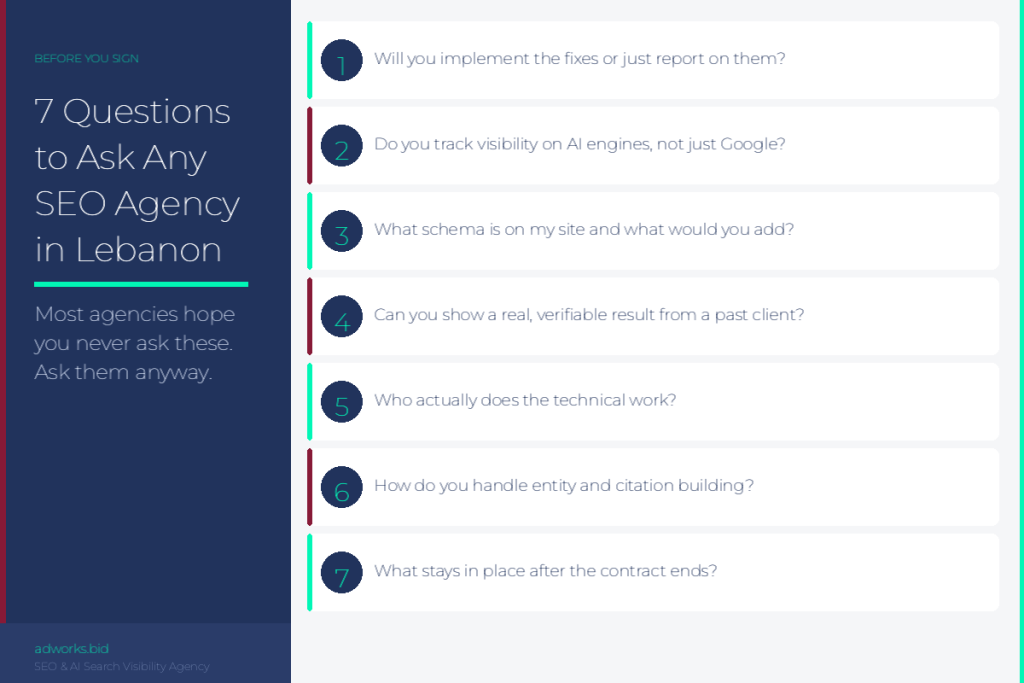
7 Questions to Ask To Learn How to Choose an SEO Agency in Lebanon
1. Will you actually implement the fixes you find, or just report on them?
This is the single biggest gap in the industry, and it’s the one most agencies would rather you didn’t ask directly. Most audits come back as a PDF or spreadsheet listing technical issues: slow page speed, duplicate content, missing schema. The list is usually accurate. Nothing gets fixed, because the agency doesn’t have anyone on staff who can open the code and change it. Ask plainly whether implementation is part of the price, or whether you’ll be handing that PDF to a developer with no SEO context, who then has to relearn everything the report already found.
At AdWorks Bid, every engagement includes direct implementation. You can see exactly how we work on our SEO company in Lebanon page.
2. Do you track visibility on AI engines, not just Google rankings?
A rank-tracking report tells you where you sit on Google. It says nothing about whether ChatGPT or Perplexity mention your business when someone asks for a recommendation in your industry. That gap matters more every month, since a growing share of buyers now research vendors through AI engines before they ever open a browser tab to search Google directly. Ask if the agency tracks this, and ask what the actual process looks like, not just whether the word “AI” appears somewhere on their service page.
If you want to understand why this matters before that conversation, this post on why businesses aren’t appearing in ChatGPT or Perplexity covers the mechanics directly.
3. What schema is currently on my site, and what would you add?
If the answer is vague, that’s usually a sign schema isn’t part of their real process, just a line item pulled from a proposal template. Schema markup is the layer that tells search engines and AI systems exactly what your business is and what it offers, instead of leaving them to guess from your homepage copy. We go into the specifics of what correct implementation looks like in our schema markup guide for Lebanon businesses, which is worth a read before this conversation with any agency, so you know what a real answer sounds like.
4. Can you show me a real, verifiable result from a past client?
Not a percentage on a slide. A specific, checkable outcome: a store that resolved a technical bottleneck and saw real sales movement, a business that closed an entity gap and started appearing in AI answers it hadn’t shown up in before. If an SEO agency in Lebanon can’t point to something concrete and specific, that’s worth noticing.
5. Who’s actually doing the technical work?
Many agencies hand off implementation to a junior developer or a third party with no SEO background at all. The person writing your proposal and the person touching your code are often two different people who’ve never spoken to each other. Ask directly who does the technical side and what their actual background is, not just their job title.
6. How do you handle entity and citation building?
If the answer is limited to “we submit your site to a few directories,” that’s a shallow version of what entity building actually requires. Entities are how AI systems decide whether to trust your business enough to name it, and inconsistent details across your website, Google Business Profile, and directory listings quietly work against you every time an AI system tries to cross-reference who you are. We cover this in more depth in our entity SEO guide for Lebanon. Ask how they build consistency across your Google Business Profile, LinkedIn, Clutch, and any third-party mentions, not just whether they “do local SEO.”
7. What happens after the contract ends?
SEO and AIO work compounds over time. Ask what stays in place if you decide to stop working together. Schema, structured content, and entity signals should keep functioning on their own, not disappear the moment the retainer ends. If the answer suggests your visibility depends entirely on an ongoing subscription rather than the actual work done, that’s worth factoring into your decision. A good working relationship should make your business less dependent on the SEO agency in Lebanon you hire over time, not more, and it’s fair to ask how they think about that tradeoff before you commit to anything.
Why These Questions Matter More Than They Used To
According to Google’s own documentation on AI features in Search, structured and well-corroborated content is one of the clearer signals AI systems use when deciding what to surface and who to cite.
That’s exactly what separates an SEO agency in Lebanon that can answer these seven questions confidently from one that talks around them. The difference isn’t about who sounds more polished in a sales call, it’s about who has actually built the infrastructure that gets a business noticed by both Google and the AI engines increasingly standing in front of it.
None of these questions are designed to be tricky. They’re designed to surface the difference between an agency that talks about SEO and one that actually does the work behind it. Knowing how to choose an SEO agency in Lebanon properly, before you sign anything, is a lot cheaper than finding out four months in that nothing actually got fixed.
One More Thing Worth Watching For
Pay attention not just to the answers you get, but to how quickly they come. An agency that’s actually done this work before will answer these seven questions without hesitation, because the answers describe their actual day-to-day process. An agency that’s mostly selling will need a beat to figure out what sounds right, and that hesitation is usually more telling than anything they end up saying.
It’s also worth asking these questions of your current agency if you already have one, not just a prospective new hire. Plenty of business owners assume switching agencies means starting over, when really it’s often just confirming whether the one you’re already paying is doing the work they claimed they would.
Don’t just rank. Be recommended.
Related reading: Why we do not promise rank one | What happens when you stop SEO | AdWorks Bid SEO company in Lebanon