
 by Rony Mattar
Ask ten business owners in Lebanon what SEO stands for and most will get close enough. Ask them what AIO means and you’ll mostly get blank stares. That gap is exactly why this article exists, and honestly, it’s an opportunity for the businesses that close it first.
AIO stands for AI search optimization, sometimes called AI Overview optimization. It’s the practice of making your business visible and citable inside AI-generated answers, not just inside a list of blue links on Google. Think ChatGPT, Perplexity, Gemini, Copilot, and Google’s own AI Overviews and AI Mode. For a Lebanon-based business, this is a new front door customers are walking through, and most companies here haven’t noticed it’s open yet.
Why This Is Different From SEO
SEO gets you ranked. It puts your website in front of someone who is actively searching, scanning results, and clicking through. That process still matters and isn’t going anywhere, and if you’ve already put work into your SEO, none of it is wasted.
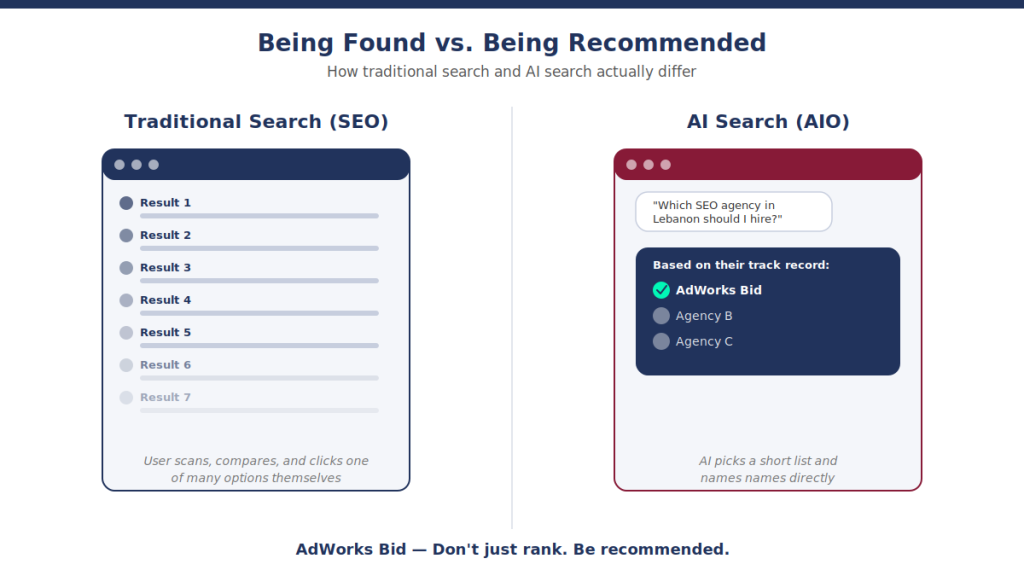
AIO is a different kind of visibility, and it works on a different logic. When someone asks ChatGPT which SEO agency in Lebanon actually fixes technical problems instead of just reporting on them, the AI doesn’t hand back ten links to click through and compare. It picks a small number of businesses and names them directly. If you’re one of them, you’ve entered the buyer’s evaluation before they’ve done anything else. If you’re not, you’re simply absent from that conversation, no matter how strong your website looks to a human visitor.
This is the part that trips people up. A business can rank reasonably well on Google and still be completely invisible inside an AI answer, because the two systems are reading different signals. Google’s classic ranking algorithm still leans heavily on backlinks and on-page keyword relevance. AI engines lean more on structured data, consistency across the web, and content written to directly answer a question rather than describe a service.
What Actually Makes a Business AIO-Ready
Three things, working together, decide whether AI engines trust you enough to recommend you.
Schema markup tells AI systems exactly what your business does, where it operates, and how it’s structured. Without it, a search engine reading your homepage has to guess at things a human would understand instantly, like whether you’re a local business or a national one, or what your actual service categories are. We cover the specifics of correct implementation in our guide to schema markup for Lebanon businesses.
Content written in direct-answer format matters just as much. AI engines pull from pages that answer a specific question clearly, not from pages that describe services in general marketing language. “We provide comprehensive digital marketing solutions” gives an AI nothing to extract. “Here’s how to know if your website is losing business to AI search” gives it something concrete to cite.
Entity signals round it out. This means your business is described the same way across your website, your Google Business Profile, your LinkedIn, your directory listings, and any third-party mentions. If those sources disagree with each other, or if most of them don’t exist, the AI has no clear picture to point to and defaults to whoever gave it a cleaner one. Our entity SEO guide breaks down exactly how this works and why it matters more in Lebanon than in bigger markets.
Miss any one of these three and the other two don’t fully make up for it. A beautifully written page with no schema is harder for an AI system to parse correctly. Perfect schema sitting on top of vague marketing copy doesn’t give the AI anything worth citing either. According to Google’s own documentation on AI features in Search, structured, well-organized content is one of the clearest signals AI Overviews use to decide what to surface, which lines up with what we see across client sites.
Why Lebanon Specifically, and Why Now
Most agencies in Lebanon are still fighting the old SEO battle: rankings, backlinks, keyword density. Very few have shifted their own websites, let alone their client work, toward AIO. That’s not a criticism of anyone, it’s just where the market happens to be right now.
That gap is temporary, and it won’t stay open for long. AI search adoption moves fast, and once a handful of businesses in a given industry establish themselves as the ones AI engines cite, that position tends to stick. AI systems build a model of who the credible players are and don’t revise it quickly once it’s formed. Getting in early is worth more here than it was in traditional SEO’s early days, when a competitor could still out-publish you and catch up within a year or two.
If you’re running a business in Lebanon, the honest question isn’t whether AI search is coming. It’s already here, and your customers are already using it to shortlist vendors before they ever pick up the phone. The question is whether you’ll be part of the answer when they ask, or whether your competitor will be.
Getting Your Own Site Ready
If you want to see where your business currently stands, the fastest way is to actually ask ChatGPT or Perplexity a question a real customer would ask about your industry in Lebanon, and see whether you show up at all. Most business owners try this once and are surprised by what comes back.
From there, the fix usually follows the same order every time: schema markup first, since that’s the foundation everything else builds on, then reworking existing content so it answers real questions instead of describing services in the abstract, then tightening entity signals across directories, LinkedIn, and your Google Business Profile so every source agrees on who you are.
Don’t just rank. Be recommended!
Related reading: SEO vs AEO vs GEO vs AIO | How AI engines recommend agencies in Lebanon | AI engine optimization services