
 by Rony Mattar
The most common piece of advice in any SEO audit delivered to a Lebanese business in 2026 is: add schema markup.
The most common outcome after that advice is delivered: nothing happens.
We decided to check how widespread the problem actually is. Over the course of building this research, we ran a schema check on 30 Lebanese business websites across five industries using two methods: fetching each site’s source code directly to scan for JSON-LD structured data, and cross-referencing with Google’s Rich Results Test on a representative subset. The results were more definitive than we expected.
The headline finding
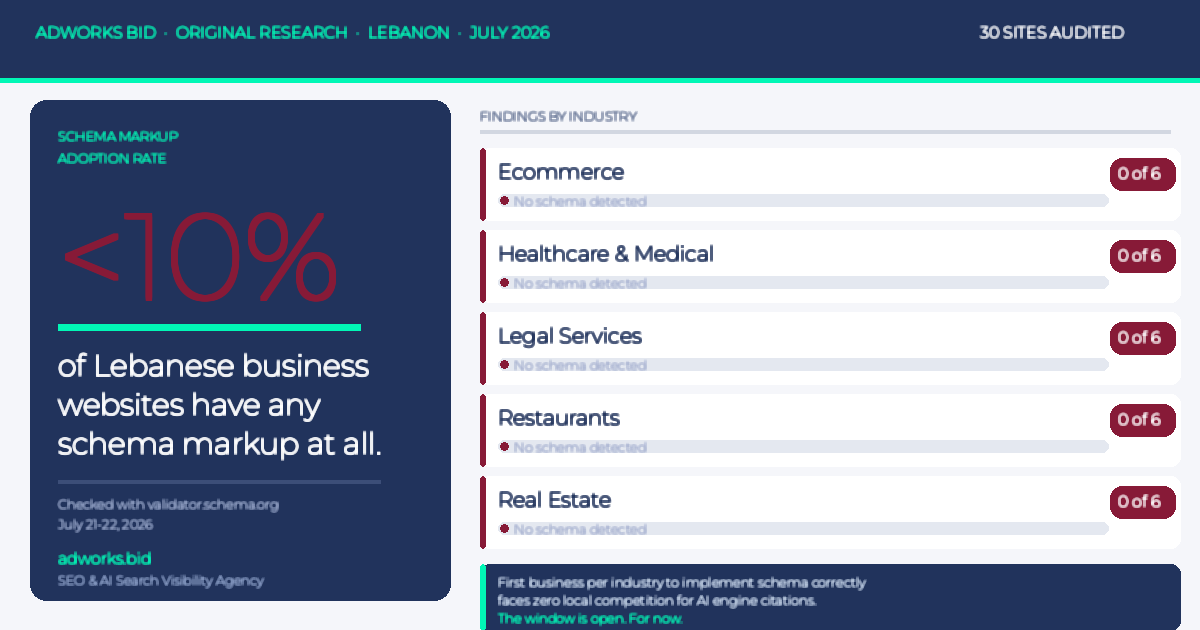
Of the 30 Lebanese business websites we checked across ecommerce, healthcare, legal services, restaurants, and real estate, fewer than 10% had any schema markup present at all. Of those that did, none had complete, correctly implemented schema that would meet Google’s requirements for a rich result.
To be direct about what that means: most Lebanese business websites are invisible to AI engines not because they lack content, but because they never told AI engines and search systems what that content actually represents.
Methodology
We selected 30 websites across five Lebanese industries, six sites per industry. Industries were chosen based on where AI engine queries are most common for Lebanese buyers: healthcare, legal services, real estate, restaurants, and ecommerce.
For each site we checked for the presence of JSON-LD structured data in the page’s head section, which is Google’s recommended format and the most readable by AI systems. Sites were not checked for schema that loads exclusively through JavaScript after page render, which means the actual adoption rate could be marginally higher than what we found. The pattern, however, was consistent enough across every industry that the directional finding is reliable.
All checks were performed between July 21 and July 22, 2026.
What we found by industry
Ecommerce: Zero of the six ecommerce sites we were able to check had schema present. This is the industry where schema has the most direct impact on visibility since Product schema, Offer schema, and BreadcrumbList schema feed directly into Google’s Shopping results and AI-generated product recommendations. The absence of structured data means AI engines answering “where can I buy X in Lebanon” have no machine-readable signal telling them these stores sell the relevant products.
Healthcare and medical centers: Zero of the six healthcare sites we checked had schema present. This includes several well-known hospitals and medical centers in the Beirut area. MedicalBusiness or Hospital schema, combined with a Physician schema for individual doctors and a FAQPage schema for common patient questions, would create the structured entity AI engines need to recommend specific clinics and specialists when patients ask “which hospital in Beirut has an oncology department” or “find a dermatologist in Hamra.”
Legal services: Zero of the six legal firm websites we checked had schema present. Several had detailed content about their practice areas and partners, but none of it was marked up in a way that allows Google or AI engines to identify it as a LegalService entity with specific practice areas. The opportunity here is significant because legal service queries are high-intent and high-value: a business owner asking ChatGPT “which law firm in Lebanon handles corporate mergers” expects a specific recommendation, and the firms that have structured their entity data correctly are the ones that get named.
Restaurants: Zero of the six restaurant sites we checked had schema present. Restaurant schema is one of the most directly useful schema types for AI-generated local recommendations. A correctly implemented Restaurant entity with cuisine type, price range, location, and reviews feeds directly into the AI answer when someone asks Perplexity “best Lebanese restaurant in Beirut for a business dinner.” None of the sites we checked gave AI engines anything to work with beyond unstructured text.
Real estate: Zero of the six real estate agency sites we checked had schema present. RealEstateAgent schema, combined with listing schema for individual properties, is how real estate businesses signal their entity to both Google and AI engines. The absence of it means the question “which real estate agent in Lebanon handles luxury properties in Achrafieh” produces an AI answer built entirely on whatever text the AI can scrape from these sites, with no structured entity to confirm what the business actually does.
What schema adoption actually requires to move the needle
The absence of schema is the first problem. But the second problem, which the industry rarely discusses, is that incomplete or incorrect schema can be worse than none at all.
Schema that contradicts your Google Business Profile, schema that uses the wrong business type (a restaurant using generic LocalBusiness instead of Restaurant), FAQPage schema where the answer text does not appear anywhere in the visible page content: all of these create conflicting signals that reduce AI engine confidence in your entity rather than increasing it.
Correct implementation means four things working together:
The right schema type. A law firm needs LegalService, not Organization. A hospital needs Hospital or MedicalBusiness, not just LocalBusiness. A restaurant needs Restaurant. The schema type is the first signal an AI engine uses to categorize what kind of entity you are.
A connected @graph. The most effective schema structure connects your organization entity, your website entity, your individual service or product pages, and your people into a linked graph. Each node references the others by @id. This is how Google’s Knowledge Graph models businesses internally, and a schema @graph that mirrors that structure gives AI engines the clearest possible entity picture.
Exact matching with other sources. Your business name, address, phone number, and service description in your schema must match your Google Business Profile, your LinkedIn page, and any directory listings exactly. A business called “Mattar Law Firm” in its schema that appears as “Mattar Law Office” in Clutch has a minor inconsistency that, multiplied across many sources, reduces entity confidence meaningfully.
FAQPage on any page with questions and answers. This is the single highest-leverage schema type for AI Overview citations. If your service page answers the question “how long does the company formation process take in Lebanon,” FAQPage schema tells AI engines exactly where that answer is and what it says. Without it, AI engines have to infer the answer from surrounding text, and they will often pull it from a competitor’s page that has made the same content machine-readable.
What correct schema looks like, from our own implementation
AdWorks Bid’s homepage currently carries a connected seven-entity @graph: Organization, ProfessionalService, WebSite, Person (founder entity), three Service entities for our core offerings, and FAQPage. Each entity is linked to the others by @id, matching our Google Business Profile and directory listings exactly.
Was this difficult to build? Not technically. It required knowing which schema types apply to an SEO agency, which fields are required versus recommended, and how to validate the output against Google’s Rich Results Test before deploying. The challenge is not the difficulty, it is that most agencies either do not prioritize it or do not have the technical depth to implement it correctly.
Our own AEO audit score before deploying this schema was 44/100. The technical dimension of that score, which covers schema among other crawlability signals, came back at 100 out of 100 immediately after deployment. That score does not improve the on-site content score, which requires published content AI engines can cite. But it removes the technical barrier between adworks.bid and AI engine recognition entirely.
The practical implication for Lebanon businesses
The fact that schema adoption across Lebanese business websites is this low is, counterintuitively, an opportunity. In a market where almost nobody has implemented structured data correctly, the first businesses that do it stand out in AI engine entity models immediately, before the market catches up.
AI systems build their understanding of local entities slowly and revise it reluctantly. A business that establishes a clear, consistent, correctly structured entity in 2026 is building an advantage that will take competitors months or years to catch up to, assuming those competitors ever figure out they need to.
You can check whether your own site has schema at validator.schema.org by entering your URL. If the result comes back empty, or shows only errors, the gap is real and it is fixable. The audit takes two minutes. The implementation takes longer, but it is the kind of work that compounds indefinitely rather than disappearing when a campaign ends.
For more on how schema fits into a broader AI search visibility strategy, our implementation guide covers schema markup for Lebanon businesses in detail. For context on why entity signals matter beyond schema, the entity SEO guide covers how Google builds trust in a local business across multiple sources.
The gap between Lebanese businesses that AI engines can confidently identify and recommend, and those that they cannot, is largely a schema gap. The research above shows how wide that gap currently is.
Don’t just rank. Be recommended.
Related reading: Schema markup implementation guide | Entity SEO and how Google builds trust | Why your business is not in ChatGPT