
 by Rony Mattar
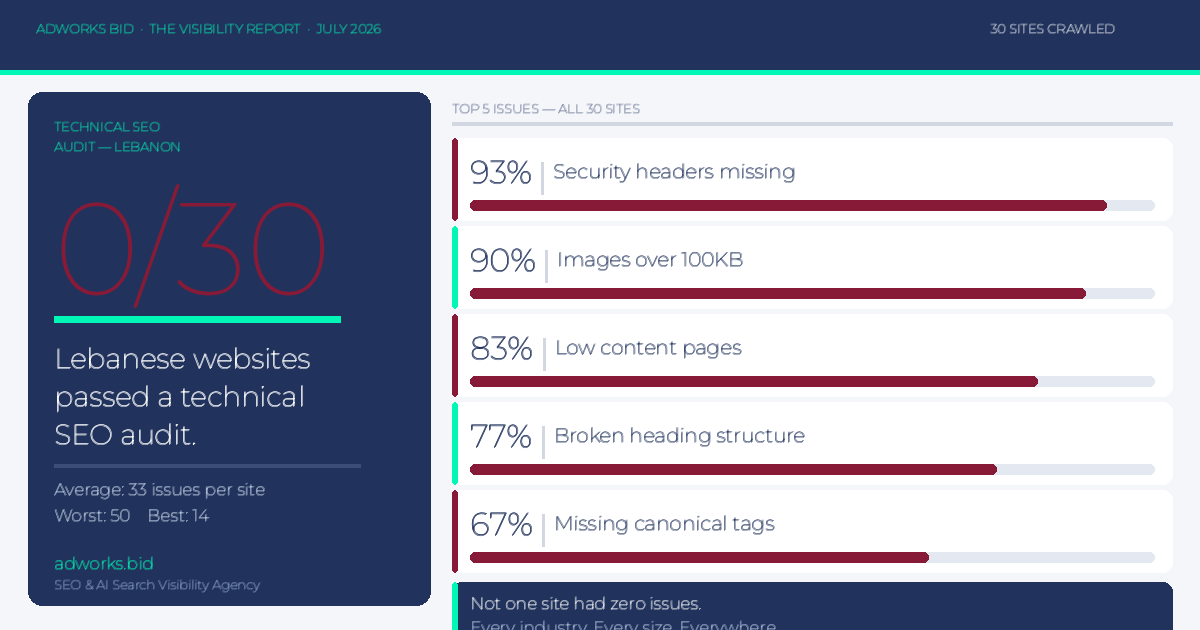
We ran a full technical SEO crawl on 30 Lebanese business websites across five industries using Screaming Frog. The result: not a single site came back clean. The average site had 33 technical issues. The worst had 50. The best had 14. Every single one of them had problems actively working against their Google rankings and AI engine visibility.
This is the second installment of The Visibility Report by AdWorks Bid. In the first, we found that fewer than 10% of Lebanese business websites have schema markup. In this one, we found out what else is broken once you look past the schema gap.
Inside Lebanon’s Website Technical Health: The Full Picture
Methodology
We crawled 30 Lebanese business websites between July 21 and July 23, 2026 using Screaming Frog SEO Spider. The sample covered five industries: ecommerce (5 sites), healthcare and medical centers (7 sites), legal services (6 sites), restaurants (6 sites), and real estate (6 sites). For each site we exported the Issues overview report, which flags errors, warnings, and optimization opportunities across the full crawl. We categorized every issue by type and mapped it against each industry to find the patterns that cross sector lines.
One note: Screaming Frog distinguishes between Errors (broken, needs fixing), Warnings (not ideal, should fix), and Opportunities (optimization gaps worth addressing). What we found across Lebanese business websites was almost entirely in the Warning and Opportunity categories, meaning most of these issues are not catastrophic today, but they are compounding quietly every month they go unfixed.
The headline finding
The average Lebanese business website carries 33 technical SEO issues. Healthcare sites averaged the highest at 42 issues per site. Restaurants averaged the lowest at 27, though even the cleanest restaurant site in the sample carried 15 issues.
Every industry, every site, something to fix.
The 5 most widespread problems
These are the issues that appeared across more than two-thirds of all 30 sites, regardless of industry or site size.
Problem 1: Security headers are almost universally missing (93% of sites)
The single most common finding across the entire dataset: 28 of 30 Lebanese business websites are missing the Content-Security-Policy header, and 28 of 30 are missing the Secure Referrer-Policy header. Another 87% are missing the X-Frame-Options header. A further 83% have unsafe cross-origin links.
These headers are a trust signal to both Google and AI engines. A site missing its security headers is, from Google’s perspective, a site that has not been properly maintained. That maintenance signal feeds into overall site quality assessments. For AI engines specifically, which cross-reference multiple trust signals before deciding what to cite, a site with weak security posture is a lower-confidence source.
The fix: security headers are set at the server level, not in WordPress or the CMS. They require a developer to modify the server configuration or a hosting setup that supports custom header rules. Most shared hosting providers in Lebanon allow this through cPanel’s .htaccess configuration.
Problem 2: Images are slowing almost every site down (90% of sites)
27 of 30 sites have images over 100KB, and 87% of sites have images with missing size attributes. These two issues together are Core Web Vitals damage. An image over 100KB that also lacks declared dimensions triggers both Largest Contentful Paint delays and Cumulative Layout Shift, two of Google’s three Core Web Vitals metrics that directly influence ranking.
For Lebanese businesses, this matters more than in markets with faster average internet connections. A homepage that loads in 4 seconds on fiber loads in 9 seconds on a typical Lebanese mobile connection, and mobile is where the majority of local search traffic arrives.
The fix: compress all images to under 100KB before uploading, add explicit width and height attributes to every image tag, and implement lazy loading on below-the-fold images. This is a one-time implementation task that compounds indefinitely.
Problem 3: Low content pages AI engines have nothing to cite from (83% of sites)
25 of 30 sites have what Screaming Frog flags as low content pages, meaning pages where the word count is too thin to provide substantive answers to any query. This is the technical SEO equivalent of the schema finding from our previous research: AI engines cannot recommend what they cannot read, and they will not cite a page that says less than the question it is supposedly answering.
A services page that says “we provide comprehensive solutions” has nothing for an AI engine to extract. A services page that explains what the service involves, who it is for, how it works, and what outcome it produces has content an AI engine can actually cite. The gap between these two is not a design decision. It is a search visibility decision.
Problem 4: Heading structure is broken across most sites (77% of sites)
77% of sites have multiple H2s used incorrectly on the same page. 70% have H2 tags missing entirely. 70% have duplicate H1 tags across the site. 63% have multiple H1 tags on the same page.
Heading structure is how both search engines and AI engines understand the hierarchy and relationship of content on a page. A page with no H2s has no identifiable subsections. A page with multiple H1s sends no clear signal about what the page is primarily about. A site where every page shares the same H1 text is invisible to AI systems trying to distinguish one page from another.
Each page needs exactly one H1 containing the primary keyword for that page. Subsections should use H2 tags. The structure should mirror how a table of contents would organize the same content.
Problem 5: Canonical tags are missing on two-thirds of sites (67% of sites)
20 of 30 sites have no canonical tags. Canonicals tell Google which version of a page is the authoritative one when multiple URLs might serve similar content. Without them, Google decides on its own which version to index, often incorrectly. This splits ranking signals across multiple URLs instead of concentrating them on the one that should rank.
What each industry gets wrong most consistently
Ecommerce: Missing meta descriptions on 100% of sites
Every ecommerce site in the sample is missing meta descriptions. Without them, Google writes its own, usually pulling the first text it finds on the page, which is rarely the most persuasive summary of why someone should click your result over the next one.
Healthcare: Redirect chains and missing canonicals on 100% of sites
Every healthcare site has internal redirect chains and missing canonical tags simultaneously. This combination is particularly damaging because the redirect chains move link equity away from the canonical destination, and the missing canonicals mean Google cannot identify where that destination is.
Legal: Title tags over the pixel limit on 100% of sites
Every legal firm website has page titles that exceed Google’s pixel limit, meaning the title is truncated in search results. Law firms tend to write long formal titles where the most important words, the firm name and practice area, appear at the end, which is exactly where truncation happens.
Real Estate: 83% have broken links returning 4xx errors
Five of six real estate sites have internal links pointing to pages that return 4xx errors. Broken internal links waste crawl budget, deliver a poor user experience, and signal to Google that the site is not actively maintained.
Restaurants: 100% have page titles too short to rank competitively
All six restaurant sites have page titles below 30 characters, significantly under the 50 to 60 character range that maximizes ranking signals and click-through rate. A title like “Mayrig” tells Google almost nothing about what the page is, where the restaurant is, or what cuisine it serves. A title like “Mayrig Restaurant — Armenian Lebanese Cuisine in Achrafieh, Beirut” gives Google and AI engines the geographic entity, the cuisine type, and the location in a single readable signal.
The most and least problematic sites in the sample
At the high end, one legal firm website returned 50 issues across the crawl, the highest in the dataset. This does not mean the firm provides poor legal services. It means the website was built and launched without a technical SEO review and has accumulated issues over time without anyone flagging them. That describes most websites in Lebanon.
At the low end, the cleanest crawl in the sample returned 15 issues. The site is simple in structure, doesn’t carry a large number of pages, and avoids the complex heading and redirect problems that more ambitious site builds tend to introduce.
What this means for AI engine visibility
The connection between technical SEO and AI engine visibility is direct, not theoretical.
AI engines like ChatGPT, Perplexity, Gemini, and Google AI Overviews build their entity models from sources they can crawl, read, and trust. A site with missing security headers, redirect chains, low content pages, and broken heading structure is a site an AI engine cannot confidently parse. It will pull from it if there is no better alternative, but it will not prioritize it as a citation source over a technically healthier site saying similar things.
We know this from our own AEO audit, published as part of this research series. AdWorks Bid’s technical score on the Catalyst AEO audit came back at 100 out of 100 after addressing technical foundations. The on-site content score was 0 because we had not yet published enough direct-answer content for AI engines to cite. But the technical floor is required before the content can do its work.
None of the 30 sites in this dataset have a technical foundation strong enough to support an AI search visibility strategy. The security headers, image optimization, content depth, heading structure, and canonicals need to be resolved first. Once they are, the content and schema work can compound on a stable base.
For context on what correct schema implementation looks like once the technical foundation is in place, our schema markup guide for Lebanon businesses covers the specific types and structure that feed directly into AI engine entity recognition. And if you want to understand why the entity signals matter beyond the technical layer, our entity SEO guide explains how Google builds trust in a local business across multiple sources.
How to check your own site
Screaming Frog offers a free version that crawls up to 500 URLs, sufficient for most Lebanese business websites. Download it at screamingfrog.co.uk, enter your domain, run the crawl, and click the Issues tab.
If you want a professional audit that maps your technical issues to AI engine visibility impact, rather than a raw list of warnings to work through alone, the AdWorks Bid website audit and SEO service covers both the technical layer and the AI citation layer as a connected system.
The gap between Lebanese business websites that AI engines can find, read, trust, and cite, and those they cannot, is not primarily a content gap. It is a technical gap. The data above shows how wide that gap currently is, across every industry we checked.
Don’t just rank. Be recommended.
Related reading: Schema markup guide for Lebanon businesses | Entity SEO in Lebanon | AdWorks Bid SEO services in Lebanon